A quick answer
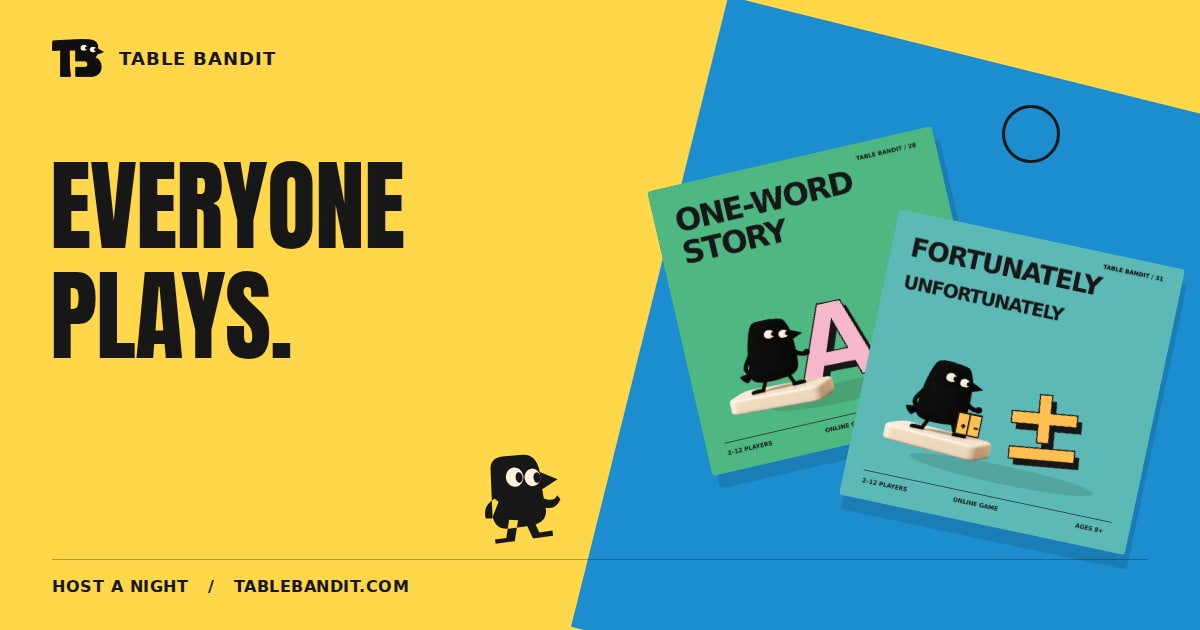
One-Word Story and Fortunately / Unfortunately create something together. A cooperative 20 Questions round adds a shared goal. Skip the running score while keeping each game’s turn rules and ending.
Choose your starting point
| Game | Players | What you do |
|---|---|---|
| One-Word Story | 2–12 | Build one ridiculous story together, saying exactly one word per turn. |
| Fortunately / Unfortunately | 2–12 | Tell one shared story, alternating good news and bad news one sentence at a time. |
| 20 Questions | 2–12 | One player knows the secret thing. Everyone else has twenty yes-or-no questions. |
What it looks like
“Fortunately, we found a map.” “Unfortunately, it was drawn by a cat.” “Fortunately, the cat came with us.” Each person adds one sentence, alternating the good and bad news. Nobody needs to award a point.
One-Word Story
2–12 players · Talk together
Build one story a word at a time. Listen to the sentence already in progress and add something that carries it forward. You can finish when the story reaches a satisfying ending, then begin again with a different opening. There is no need to nominate a best word or a winning player.
Rules, examples & play
Fortunately / Unfortunately
2–12 players · Talk together
Fortunately / Unfortunately alternates good news and bad news, one sentence per player. Each sentence responds to the previous one. Keep the same central character or situation so the result feels like a story instead of unrelated jokes. The pleasure is in rescuing, then complicating, each other’s ideas.
Rules, examples & play
20 Questions
2–12 players · Private answer
Play as one guessing group against the twenty-question limit. The answer holder responds truthfully with yes or no, and everyone else narrows down the possibilities. Once the secret is found or the questions run out, reveal it and give someone else the answer-holder role. A successful solve is enough; no league table is necessary.
Rules, examples & playAgree on an ending before you begin
Score-free does not have to mean endless. For a story, agree to wrap up after everyone has contributed a few times. For a puzzle, use the game’s question limit. A clear ending makes it easier to change games without one person feeling that the group stopped in the middle of their turn.
Skip points, keep the rules that make the game work
A hidden-role game still needs its votes and win conditions. Fishbowl still needs the same bowl to return across its clue rounds. Leaving Add score unused is different from abandoning the structure of a match. For the loosest evening, choose one of the three games above rather than removing essential steps from a competitive game.
Use New round deliberately
New round gives the group a fresh start. Use the normal turn or phase controls while you are still completing the current game. Tell everyone before restarting, particularly when secret roles or private answers are involved. Add score is available if you later decide to record a round winner.
Before you start
- Agree when a round ends.
- Let the next person change the story.
- Use New round for a fresh start, not to skip a required phase.
One more thing
Does leaving the scoreboard empty stop the game?
No. The social scoreboard is optional. You still need to use any answers, votes or turn controls required by the particular game. The rules screen explains those steps.
Player counts and rules refer to the Table Bandit versions linked here. Practice examples are illustrative and may differ from generated prompts. For remote play, use a separate voice or video call.
Find your game